
Project Story#
Here is a story that describes the watex project design.
Introductory Notes#
Water is an indispensable resource globally, facing significant challenges in this century due to climate change. Beyond its use in industries, electronics, services, and companies, water remains a scarce commodity, particularly in developing countries. Indeed, water treatment processes are costly, with only developed nations typically able to afford comprehensive treatment solutions.
The genesis of the WATex project dates back to 2015, within the geosciences and civil engineering operations company (IBS+). Selected as a geophysical engineer for this venture, my mission was to facilitate access to potable water across various regions of Côte d’Ivoire and beyond. Noteworthy examples of our work outside CIV include the Community Drinking Water Supply (CDWS) projects in West African sub-regions like Niger, Guinea, Mali, and Burkina. These projects received partial funding and support from international organizations such as the World Bank and UNICEF, alongside the governments of the host countries, under initiatives like PNAEP and PPU in Côte d’Ivoire.
The Development Journey#
Our experiences in these regions highlighted the acute need for efficient and reliable methods to locate groundwater resources. Traditional approaches, while effective to some extent, often resulted in high rates of unsuccessful drillings, leading to wasted resources and diminished hope among the communities we aimed to serve.
Recognizing this, we embarked on the development of WATex as a tool to harness the power of machine learning for water exploration. Our goal was to significantly improve the accuracy of groundwater detection, thereby reducing the risk of unsuccessful drillings and maximizing the impact of available resources.
WATex was envisioned as a user-friendly, open-source platform that could democratize access to advanced geophysical data analysis, making it accessible not only to professionals in the field but also to local communities and small-scale operations.
Trigger Effect#
Although enhancing the living conditions of the population remains one of my primary
concerns, the catalyst for watex’s development was the Diacohou-Nord project in 2017,
located in the central part of Côte d’Ivoire (see Figure 1). This project was unique in
its aim to identify the optimal location for drilling operations to achieve a flow
rate (FR) of \(10m^3/hr\) (referred to as RFR). The area faced significant challenges with
drinking water availability, especially during the dry season. The topographic and
terrain constraints, among others, were not conducive to achieving the desired FR,
exacerbating the living conditions of the local population.
During our visit, from 6 P.M. to 6 A.M. daily, women in the village ventured into the forest to find potable water for their families (Figure 1.a). The water collected from lowlands, marsh areas, and distant forest rocks served as an alternative source when local wells and boreholes dried up, despite the risks posed by wild animals.
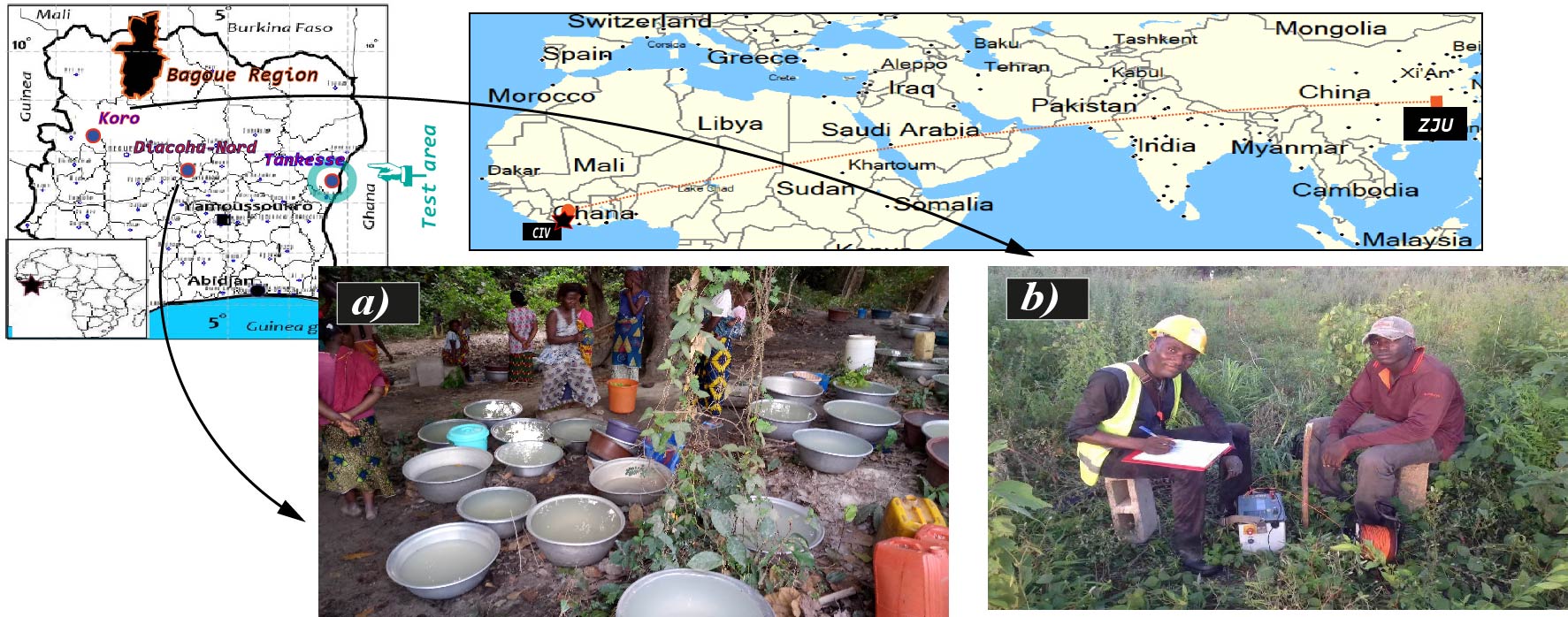
DC-resistivity survey investigations. a) An illustration of the critical water shortage issue in Diacohou-Nord. Women wait for water in the forest from night until morning. b) DC survey investigations in the “Koro” locality, north area of Côte d’Ivoire.#
The quest for water at night in the forest led to numerous and severe consequences, including snakebites. On May 17, 2017, I witnessed a woman bitten by a snake, who was then urgently transported to the nearest city for treatment. This incident highlighted the common and dangerous challenges faced by the community in their daily quest for water.
Motivated by this experience, I decided to address this issue to prevent such incidents from recurring. Two months later, I resigned from the company and sought scholarship opportunities to study programming and artificial intelligence. My goal was to develop a machine capable of detecting underground water reservoirs and estimating the FR based on the population’s needs, even during dry seasons.
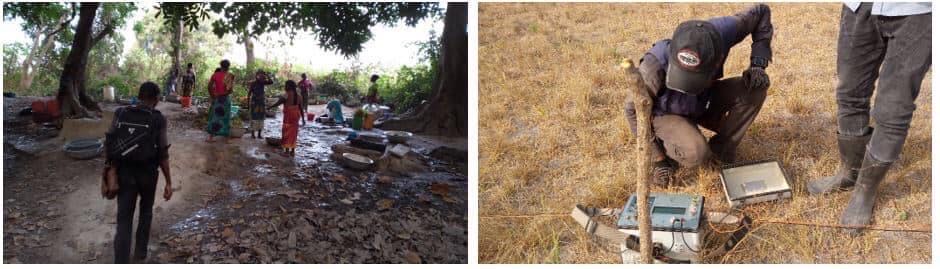
Women seeking drinking water: left-panel) The site where a lady was bitten by a snake. Early in the morning, my team and I inspected the site to propose alternative solutions; right-panel) Survey investigation in Diacohou-Nord locality. The grass’s color shows the harsh effects of the dry season in this area.#
Three months later, I was fortunate to receive a scholarship from the China Scholarship Council (CSC)
(CSC) in collaboration with the Côte d’Ivoire government
for a Ph.D. candidacy. I enrolled at Zhejiang University (ZJU) in 2018, where
my research focused on computational geophysics. My projects aimed to develop
new ML approaches for detecting fracture zones and predicting FR efficiently
using DC-resistivity`and electromagnetic data (notably :term:`CSAMT). Thus, the initial
version of watex was conceived, centering on a case study in the Bagoue
region (see Figure 1). The outcomes were promising, achieving a 77% accuracy
rate in FR predictions with a reasonable amount of data.
Efficiency Test#
To evaluate the software’s effectiveness in a new location outside of the Bagoue region,
data were acquired from a local company, GEOTRAP SARL, in
the Tankesse area of the Indenié Djuablin region (east of CIV, see Figure 1). The gathered data
were processed and analyzed using watex’s watex.methods.electrical algorithms to
automatically identify favorable drilling stations (highlighted in blue) and select the optimal one
by incorporating environmental constraints, aiming to achieve a RFR of \(5m^3/hr\). The
software ultimately recommended station S53 as the best drilling site.
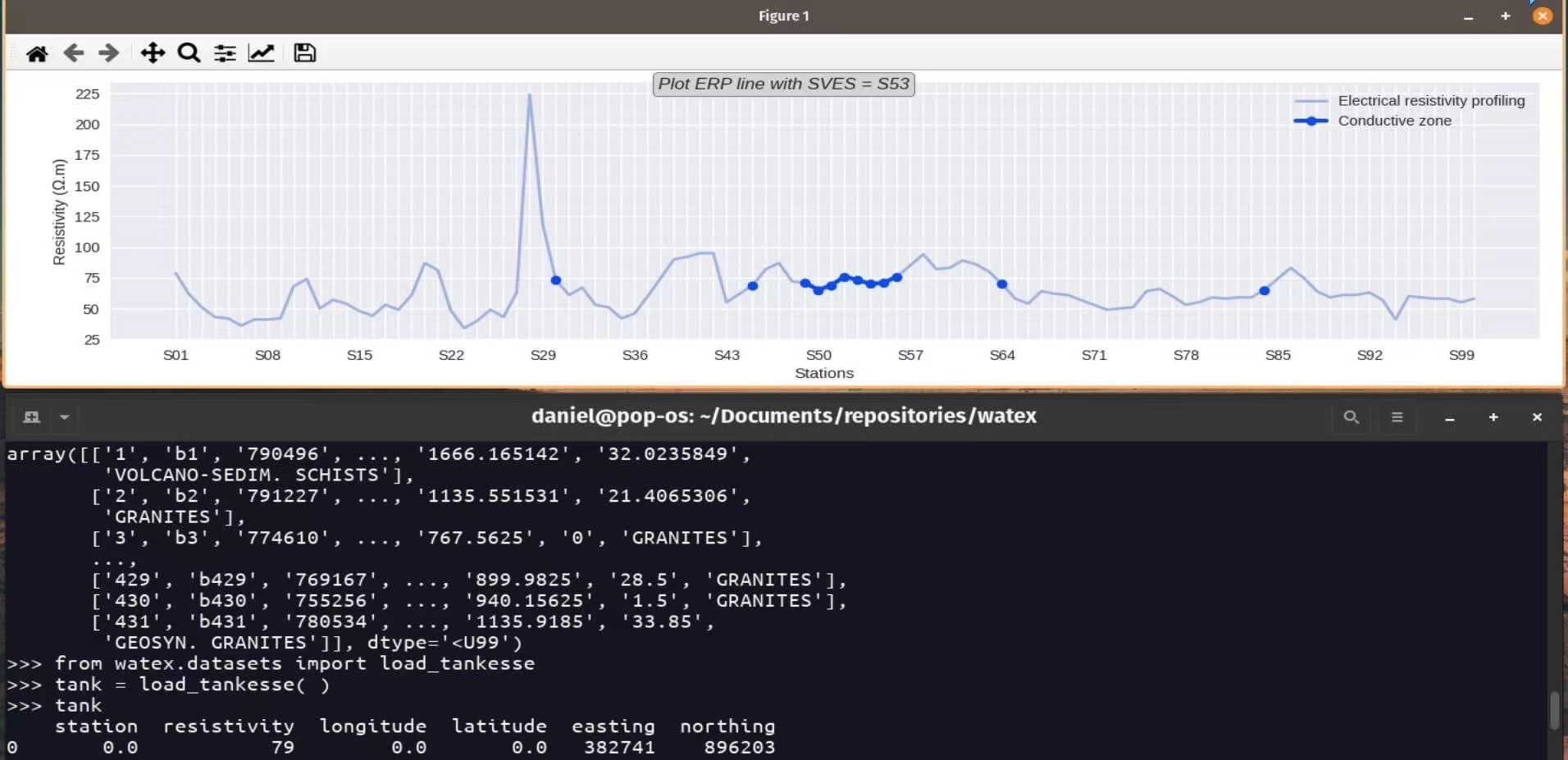
Data processing in Tankesse. Data were collected from GEOTRAP SARL.#
Remarkably, two months after drilling commenced, a flow rate of \(9.7m^3/hr\) was achieved,
surpassing watex’s prediction of \(7.3m^3/hr\) (see video).
This outcome underlines the algorithms’ conservative approach in estimating groundwater flow rates
to minimize the risk of unsuccessful drillings and reduce financial expenditures. A YouTube video
demonstrates watex’s application efficiency in future Community Drinking Water Supply (CDWS)
projects.
This success was particularly significant for the population of Tankesse, an area known for its thick
granitic layers that frequently lead to inaccurate flow rate predictions during drilling operations.
These challenges have historically resulted in numerous failed drills and unsustainable boreholes. The
application of artificial intelligence (AI) through watex has demonstrated its capability
to overcome these obstacles, marking a significant advancement for the community’s well-being in the
region. Data for the Tankesse area can be accessed via watex.datasets.load_tankesse().
Impact and Future Vision#
Since its inception, WATex has grown from a concept to a functional tool that has been applied in several practical projects, demonstrating its potential to revolutionize water exploration practices. By integrating machine learning algorithms with traditional geophysical methods, WATex offers a novel approach that enhances the prediction and analysis capabilities of researchers and practitioners alike.
Looking forward, we are committed to continuous improvement and expansion of WATex’s capabilities. Our aim is not only to refine its technical aspects but also to foster a community of users and contributors who can share experiences, data, and strategies for effective water exploration.
As we navigate the challenges of climate change and water scarcity, WATex stands as a beacon of innovation, offering hope and practical solutions for sustainable water management across the globe.
The journey of WATex is a testament to the power of collaborative innovation in addressing some of the most pressing environmental challenges of our time. It underscores the critical role of technology in enhancing our understanding and management of natural resources, paving the way for a more sustainable and water-secure future.
For more information about the projects and organizations mentioned, please visit the following links:
Conclusions#
watex emerges as a cost-effective tool by leveraging economical geophysical
methods (ERP and VES) to predict the expected flow rate (FR),
which correlates with the population size of a locality for long-term water
exploitation. For instance, if the population of a given area increases from
2,000 to 50,000 inhabitants over ten years, the required flow rate (RFR) of
\(3m^3/hr\) suitable for 2,000 people will become insufficient in a decade
due to population growth and climate change impacts. Hence, watex presents
itself as a viable solution to minimize the frequency of unsuccessful and
unsustainable drilling efforts.
Beyond addressing issues directly tied to hydrogeological exploration, watex
also presents additional valuable features. Looking ahead, it aspires to become a
key library in the groundwater exploration (GWE) domain within the next five
years, enriched by the collective efforts and contributions from a diverse
group of project participants.
See also
For a quick comprehension of the project’s inception, refer to five-minutes.
Credit to the author.