Note
Go to the end to download the full example code or to run this example in your browser via Binder
Auto-detect the drilling location#
Auto detect the suitable drilling point for drilling operations using the naive auto-detection and the auto-detection with the constraints application.
# Author: L.Kouadio
# Licence: BSD-3-clause
For this example, we randomly generate 50 stations of synthetic ERP resistivity data with minimum and maximum resistivity values equal to 1e1 and 1e4 ohm.m respectively as:
import watex as wx
data = wx.make_erp (n_stations=50, max_rho=1e4, min_rho=10., as_frame =True, seed =42 )
Naive auto-detection (NAD)
The NAD automatically proposes a suitable location with NO restrictions (constraints) observed in the survey site during the GWE. We may understand by suitable, a location expecting to give a flow rate greater than 1m3/hr at least.
robj=wx.ResistivityProfiling (auto=True ).fit(data )
robj.sves_
'S025'
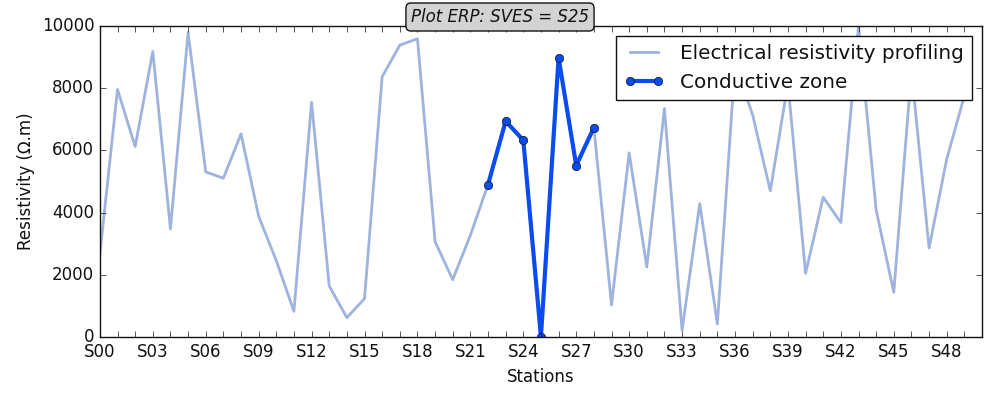
The suitable drilling location is proposed at station S25 (stored in the attribute sves_).
Auto-detection with constraints (ADC)
The constraints refer to the restrictions observed in the survey area during the DWSC. This is common in real-world exploration. For instance, a station close to a heritage site should be discarded since no drilling operations are authorized at that place. When many restrictions are enumerated in the survey site, they must be listed in a dictionary with a reason and passe to the parameter constraints so these stations should be ignored during the automatic detection. Here is an example of constraints application to our example.
restrictions = {
    'S10': 'Household waste site, avoid contamination',
    'S27': 'Municipality site, no authorization to make a drill',
    'S29': 'Heritage site, drilling prohibited',
    'S42': 'Anthropic polluted place, avoid contamination within a few years',
    'S46': 'Marsh zone, borehole will dry up during the dry season'
 }
robjc=wx.ResistivityProfiling (constraints= restrictions, auto=True ).fit(data )
robjc.sves_
/home/docs/checkouts/readthedocs.org/user_builds/watex/checkouts/0.2.3/watex/utils/coreutils.py:1531: UserWarning:

'S33' seems close to a restricted area. It is recommended to not take a risk by considering S33 for drilling operations. You may leave this station and carry out another ERP line far away this site. Force considering S33 with its  resulting DC-parameters is your own risk.


'S033'
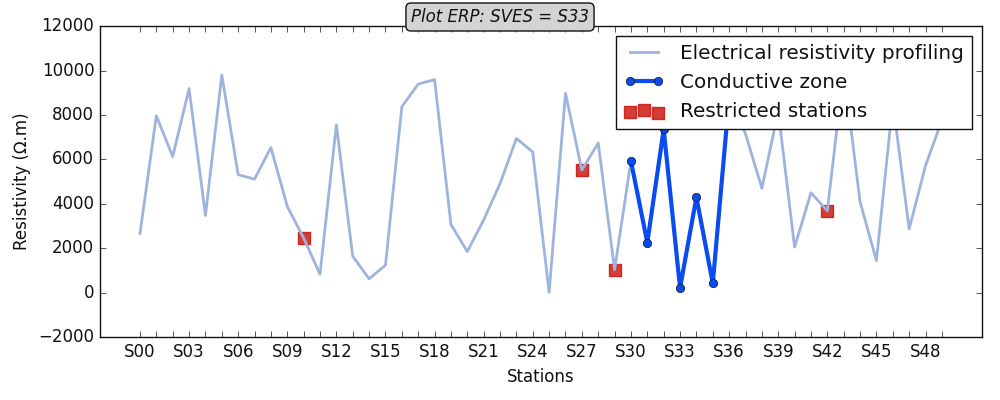
Plot ERP including the restricted stations.
robjc.plotAnomaly(style ='classic')
<AxesSubplot:xlabel='Stations', ylabel='Resistivity (Ω.m)'>
plot the selected conductive zone wih No cpnstraints
robj.plotAnomaly(style ='classic')
<AxesSubplot:xlabel='Stations', ylabel='Resistivity (Ω.m)'>
When the constraints is applied, the selected conductive zone is move to the station S33 by ignoring the station S25 close to the restricted stations S27 and S29. Even the user might discarded this station also. Now taking the risk for making a drill or rejected the propose station will depend to the technician on the site. Commonly when the station is close to the restricted area, it is better to avoid the possibility to make a drill at that station.
Notice, the station S25 is no longer considered as the suitable location and henceforth, propose S33 as the priority for drilling operations. However, if the station is close to a restricted area, a warning should raise to inform the user to avoid taking a risk to perform a drilling location at that location. Note that before the drilling operations commence, make sure to carry out the DC-sounding (VES) at that point.
Total running time of the script: ( 0 minutes 0.523 seconds)
