Five minutes understanding#
This section explains the genesis of the project from CDWS and gives an overview as well as the ease comprehension of the importance of DC-resistivity methods during the campaign for drinking water supply (CDWS).
What ERP and VES are ?#
The electrical resistivity profiling (ERP) and the vertical electrical sounding (VES) are geophysical subsurface imaging methods. They are most preferred to find groundwater during the CDWS, especially in developing countries due to their low cost and the assumption of being the most suitable method in the basement medium. Commonly, the ERP is first used to select the best conductive zone (anomaly) based on basic criteria such as the shape, the type of anomaly, and the geology of the area [1]; [2]. Secondly, the VES is carried out to speculate about the existence of a fracture zone and the layer thicknesses. Indeed, the goal of combining both methods is to find the best place to locate the drilling expecting to give a FR above or equal to the project-required FR (RFR).
Why RFR is so much important in CDWS ?#
Typically, the RFR is tied to the type of hydraulic system which is based in turn on the number of inhabitants living in the exploration locality [3]. For instance, the village hydraulic (VH) is the type of hydraulic system mostly suggested for the number of inhabitants less than 1000 (\(FR\geq 1 m^3/hr\)). Likewise, the improved village hydraulic (IVH) (\(FR\geq 3 m^3/hr\)) is proposed to the population size ranged between 1000 to 4000, whereas the urban hydraulic (UH) (\(FR\geq 10 m^3/hr\)) is offered to a population size greater than 4000 ([4]; [5]; [6]). Thus, the FR obtained after the drilling operations (observed FR) under the RFR, is considered unsuccessful drilling and requires a new geophysical survey in that locality. This is expensive and the challenge of staying in the project schedule becomes a puzzle that many local companies try to work around.
What traditional techniques/tips are used to solve the unsuccessful drilling ?#
Local companies propose at most three drilling locations with their order of priority after the survey to maximize their chance to get the RFR (See figure below). Unfortunately, the idea of proposing many drilling points is not always the best solution, and the problem to find the right drilling place expecting to give the RFR remains a real challenge.
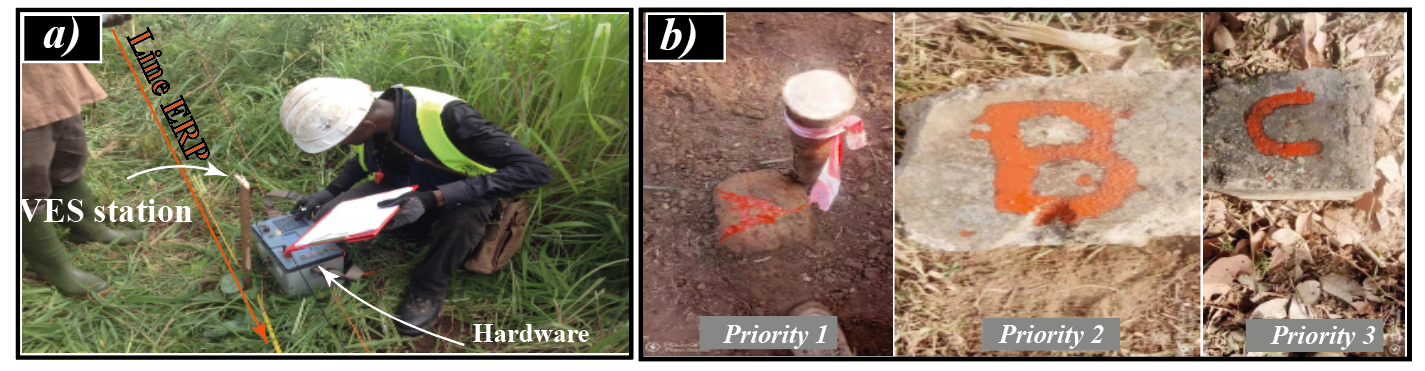
DC-resistivity methods. a) ERP and VES investigations. b) Priority for drilling operations based on the traditional methods.#
What’s novelty using WATex in GWE ?#
watex provides “smart” algorithms ( pre-trained machine learning models from watex.models.pModels )
to predict the feasible FR before any drilling operations. This is a new approach to solve the aforementioned problem,
improve the traditional geophysical methods, reduce the unsuccessful drillings, minimize the rate of unsustainable
boreholes and losses. In addition, when constraints ( site restrictions) are passed to the watex.methods.electrical.ResistivityProfiling class,
watex is capable to advise the user whether the auto-detected station is suitable for drilling or not. It also has the ability to
warn the user about the selected station close to the restricted area.
Indeed, the resolution of this GWE problem during the CDWS was the landmark of the watex design project.